Tuesday, 9 October 2012

The Waterstones Debacle


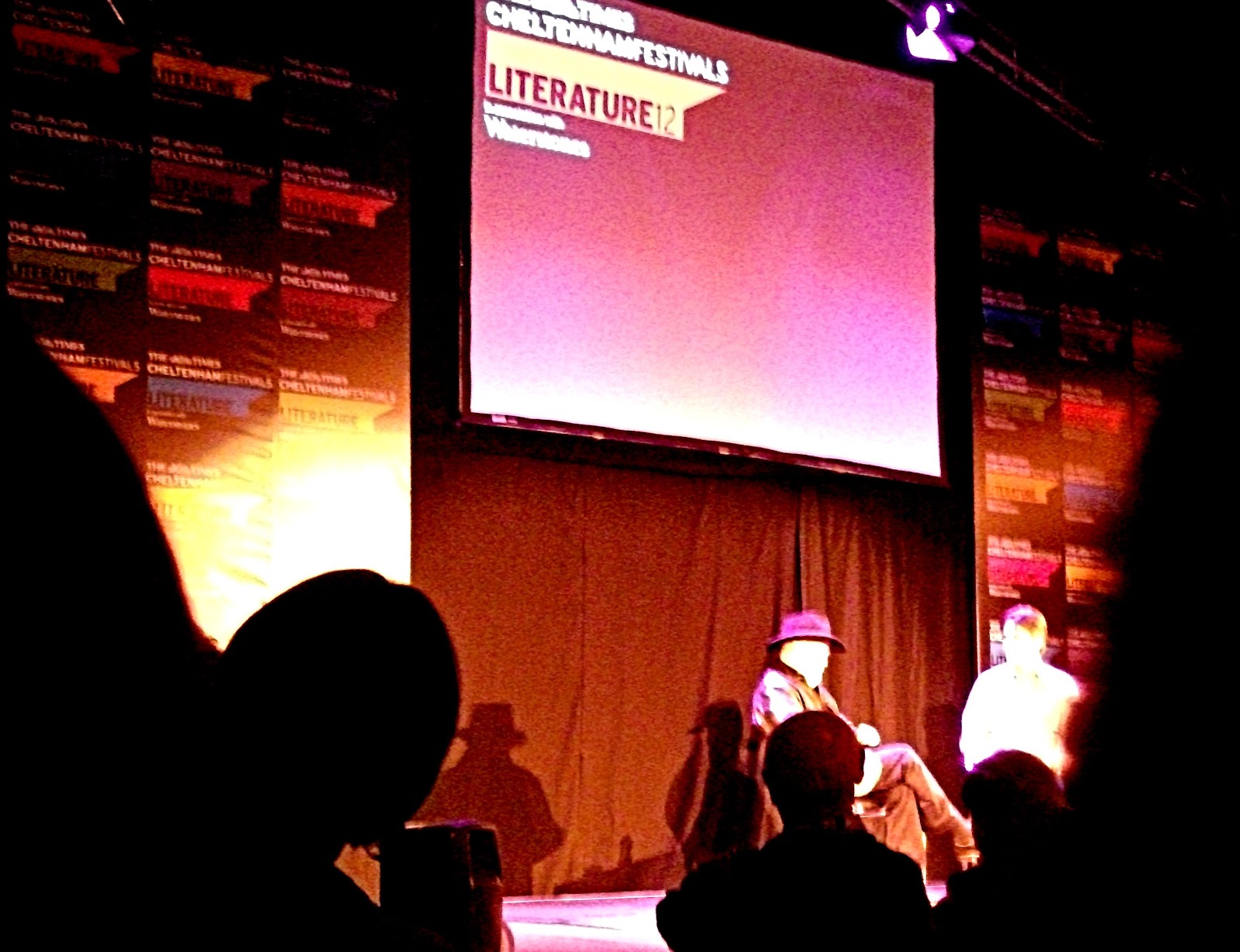
Look. Just look at that would you? Spelled above with an apostrophe and below without one. They're deliberately trying to confuse us.

Wonder how much that's costing the marketing department?

Last week I was in Matalan looking for a winter coat, on account of driving off and leaving my other one in a closet in the Midlands. Such is the hazard of road trips, and being me.

I got a bit sidetracked and ended up taking a leather-elbowed tweed jacket (I've always wanted to be an academic) and a couple of dresses to the changing rooms. Four items in all.

"How many can I take through?" I asked the lady on guard.

"Up to six," she informed me. "But I'm afraid I can only let you take three, because all the other disks have gone."

I looked at the peg and made the following observation:

"Could you give me three plus one? That would make four."

"No. I'm afraid I'm not allowed to give you two disks."

I bit my tongue, stopping just short of saying, "Do you think, given the fact there's just you and me standing here, perhaps you could look at my face and remember the number of clothes I am taking with me? I mean, you look fairly sentient, a few years off senility at least. Perhaps you could even write it on the back of your hand? I'll only be five minutes. You can body cavity search me on the way out if you like, I might even enjoy that. After all, it's only four items. I'm not asking you to divide it, multiply it, or find the square root. Just remember the number four."

Pet peeve. I hate shops that don't wish to sell you stuff. I can't help thinking they're in the wrong line of business. I will always throw half the clothes back rather than call out to a shop assistant to swap them over halfway through my dressing room experience. I'll wager that, by treating everybody like crooks, shops have lost quite a bit of money from genuine customers who can't be bothered with the hassle.

Which brings me neatly around to Waterstones and Cheltenham Literature Festival. 


The morning of Philip Pullman, we were at the top field Watersones selecting books for the signing. I'd picked up a money-off coupon a few months back. Collect ten stamps at £10 each and get £10 off. £10 off £100 hardly seems worth the effort, but stores know the value of this type of loyalty card. It's like Pokémon, you gotta catch 'em all.

Given that we're a family of book lovers, it didn't take long to collect a full score card. We gave the completed card to Marilyn to put towards the full collection of His Dark Materials. Off she went to the counter.

"I'm sorry," they said. "We're not able to take vouchers here because our till is playing up. Try Imperial Square."

The Literature Festival is split between Montpellier Gardens (upper field) and Imperial Square (lower field). Both have a Waterstones bookstore. However, as we learned, these two stores operate independently during the festival.

So, down we wandered to the 'other' tent, to look for a copy of His Dark Materials.

As it transpired, they didn't have it. The book was in one tent. Our ability to use the voucher, in another.

Simple A to B solution, one might think? Send book from top tent, to bottom tent.

Instead, staff asked to see our receipts for the books we had already bought at the other tent. We must have looked shifty, and the fact we were carrying them in Waterstones bags must have come across as a real ploy. Obviously we were in a Waterstones tent asking to buy books because we were stealing them. More than a little insulting having just given them £100.

Satisfied with our receipts, they then ummed and aahed about the problem, looked at one another, radioed back and forth and, eventually, decided that if Marilyn wanted the book, she could go back and get it.

Off she went, back up to Montpellier Gardens. Meanwhile, I listened to the staff discussion over the walkie talkie. 

"Okay, the customer is on her way to the tent now."

"Has she paid for the book?"

"No, but her daughter," (I presume, referring to me?) "is here and she's left lots of stuff."

"We can't let her leave the tent with the book."

"Honestly, she's left lots of stuff here." The unspoken subtext, in front of her assumed daughter, being 'we don't think she's a criminal, low risk of running off with the merchandise.'

"Still, we can't let her leave the tent unless the book is paid for."

"Oh."

Long pause.

"Can you ask her daughter to pay for the book?"

"That's a good idea. How much is it?"

I interrupt to tell her that it's "sixteen ninety-nine."

"Right," she says, back into the walkie talkie, tapping a few buttons on her till. "What's that? Fourteen ninety-nine."

I know she's made a mistake, so repeat the correct price. 

She hits some more buttons. "What's the ISBN again? Fourteen ninety- Oh, wait, that's wrong." Looks at me and smiles. "That's sixteen ninety-nine, is that alright?"

Honestly, what can you say?

I nod.

"So, six ninety-nine with the discount."

I pay.

Naturally, they don't bother to tell Marilyn, so she arrives back at the tent, out of breath, fed up, and about to go to the counter to pay again.

Yes, yes, a rant, I know. But it absolutely mystifies me. This is so common of big business in Britain. A bumbling, round-the-houses approach to service. You're the country's largest bookshop, at one of the country's largest literature festivals. You have one job to do: sell books. As efficiently, one would hope, as possible.

Systems thinking it ain't.

Still, that in itself wasn't the debacle. That was a mere annoyance.


For crying out loud - which is it!?

The interesting point arose whilst standing outside the tent, explaining to Marilyn that the book had been paid for and we were free to go.

A gentleman positioned himself next to the entrance, and began handing out glossy, expensive-looking flyers for his book to people going in.

Within seconds, a member of staff came out of the bookshop and told him to cease and desist.

At which point, he threw an impressive over-armer, narrowly missing a septuagenarian, and scattering his flyers against the opposite tent. He stormed off, leaving the staff member to collect up the debris.

I'm annoyed now that I didn't pick one up. 'Vandalism' - perhaps. 'Hooliganism' - maybe. Yet I can't help feeling that such a display of passion deserves some form of recognition.

I rather feel I understand his frustration.

The problem with Cheltenham Literary Festival (and I've sung its praises enough to be allowed a moment of critical observation), is that there is precious little encouragement for local or aspiring writers. It is very much about the big, established, names. 

This isn't a bad thing in itself. This is what it has built its reputation upon, and why we return year after year.

However, it also builds an air of elitism. 

At the arts festival, there is a wall set aside where local artists can come and display their works. If Waterstones had been canny about it, they could have defused the flyering situation much more easily, and with much more grace, by explaining "Sorry, you can't flyer outside the door, but if you give us some, we'll display them on our board inside." Or "There's a board over there especially for authors to advertise." What harm does it do the festival or the book seller to promote more books and make authors feel good about themselves?

Even the Society of Authors is guilty of promoting this sense of 'worthy or not'. They sent out an invitation to their members for (I think it might have been local) authors to submit work for a potential reading at the festival. Yet even in this day and age of the automated - polite - response, they couldn't bring themselves to send out even an e-mail of recognition. It was very much along the lines of a job interview, or an agent submission: 'don't call us, we won't call you either.'

So, it wasn't that difficult to sympathise with the frustrated author. Especially when it really doesn't have to be like that. booQfest was the perfect example. As Paul Magrs said on his blog, Life on Magrs:

It's one of the best organised book festivals I've ever been to - and probably the most fun... deliberately opening [the festival] up as something that everyone can take part in, read and listen to.

I honestly don't think Cheltenham would suffer any loss of face by opening up a few extra opportunities for new, local, and independent authors to take the stage. After all, small press made up 50% of the Booker shortlist this year. Spread the love.

Monday, 8 October 2012

CheltLitFest 2012: Jenny Agutter


After Terry Pratchett, we adjourned to a lovely pub down the road for a drink and a meal. By the time we returned to the festival, night had fallen.

Our final speaker of the day was Jenny Agutter, most famed for her role in The Railway Children, and later Logan's Run. Currently appearing in Call the Midwife as Sister Julienne.

Listening to Agutter, she seems to have led a blessed career. Not least that her parents supported her choices, but also in the range of choices she was offered. Having travelled as the child of an army officer who later went into organising entertainment for the troops, she was then discovered by none other than Walt Disney, aged eleven, and went on to land a starring role in Walkabout, jetting off to Australia.

Although she herself quit school after studying ballet, to pursue a career in acting, she says that she absolutely wouldn't recommend that route to anyone else. She highlighted that part of the problem with acting as a career is that it can 'dry up at any moment.'

Question time was entertaining, at least two male members of the audience began by admitting to having been 'a little bit' in love with her in their youth.

It was nice to hear that in 2000 it felt like coming full-circle to play her own mother in Catherine Morshead's retelling of The Railway Children. She said that some actresses might have found that uncomfortable but, for her, it was a completion to watch another young actress playing her part, doing what she had done at that age. Mirroring the way that life, and families, go on.

Another hugely entertaining anecdote she told involved one of her heroes, Sir John Gielgud. She was appearing in Peter Hall's production of The Tempest at The National in her early 20s. She was due to make her entrance, playing chess with a fellow actor, up through a trapdoor in the stage. Only, during one dress rehearsal, the trapdoor opened and Sir Gielgud landed on the table between them!

Apparently he got up, shook himself down and walked off, leaving the two young actors gazing after him in surprise.

It would appear that the actor, Dennis Quilley, also remembers that incident.

Agutter just comes across as this incredibly bubbly, positive person. Despite what she may say about acting, nobody would inspire you to run off and join the theatre more.

CheltLitFest 2012: Terry Pratchett


Dashed back from a friend's party in Market Drayton yesterday and straight in to listen to Sir Terry Pratchett, legendary author of the Discworld series and staunch campaigner for euthanasia since being diagnosed with Alzheimer's.

He's just finished (finishing?) a thirteen-part television series, City Watch, based on... well, I'm sure you can guess.

Exciting news.

Also the first time that he's relinquished control of writing Discworld to other writers.

He was interviewed by his Personal Assistant, Rob Wilkins, which was nice because they obviously share a very close relationship, working together on a daily basis.

I liked the fact they have a shrine in the office to the goddess Narativia. Apparently you pray to her when the plot's running thin and she blesses you with more words. Could certainly use that at the moment.

There is another Discworld in the writing, but after that he says he'd like to write his autobiography. From snippets about the O.K. Corral and a bus full of drunken fans at border control, it's sure to be entertaining.

Wilkins ended the interview with a touchingly honest question, simply saying 'I know everyone here will wish to know - how are you?'

The answer is, he's doing well. He has tools to help him write, and the disease seems to be progressing more slowly than he had anticipated, which he has mentioned in a recent interview.

Listening to him, he does sound incredibly lucid, and quick with a joke or two, such as stopping Wilkins on the first line of the reading after he said 'interrupt me at any point.'

Wilkins read from Dodger, his latest release, which I have a copy of. Looking forward to it, though he no longer does mass signings due to arthritis. Brought about, I suspect, by people turning up with their entire Discworld collections.

I suppose one noticeable trait was that he did seem easily distracted by anecdotes. Though, never having heard him speak before, it was difficult to tell whether this was part of his condition or just part of him.

Hopefully 'a few more books yet,' as they put it. And great to hear stories of how many people seem to have shunned reading until they picked up a Pratchett. He's certainly responsible for a large proportion of literary converts, although, when asked whether his latest book contained elements of literature, he replied: "Literature? Of course not - it was written by me!"

On a slightly less intellectual note, I picked up my first Pratchett aged eleven. To be honest, it was a little over my head, but I liked the idea of taking a book with a picture of a lady with big boobs on the cover to my teacher's reading class. I'm not too sure whether she was more stunned by the cover art, or by my ability to read it out loud.

A real privilege to have the opportunity to see such a unique individual. Like most, I have loved Discworld for years. Bought the books, wore the T-shirts, played the PC games. Here's to those 'few more' to come.


Saturday, 6 October 2012

CheltLitFest 2012: Philip Pullman


Drumroll please!

Excellent seats for Philip Pullman, author of the Northern Lights trilogy, and some of my favourite YA: The Ruby in the Smoke series. He writes kick-ass female characters.

He was here promoting his latest work, a retelling of fifty of the Grimm fairytales. Happy to say we now have a signed copy of that and I'm hugely looking forward to reading it. His 'Fifty Shades of Grimm,' as he put it.

I made loads of notes on this one, so it's likely to be a lengthy post but, honestly, how often do you get to see such a grand master of literature speak?

Settle down comfortably children. I'll begin.

I really enjoyed this talk because it largely focused upon fairytales. I love fairytales, and what constantly astounds me is that many great minds also found inspiration in them. For example, Einstein, who reputedly said: “If you want your children to be intelligent, read them fairy tales. If you want them to be more intelligent, read them more fairy tales.”

The first thing I noticed about Pullman, is that his hair has grown. You're used to seeing him in publicity shots with short hair, but the white tufts he now sports make him look altogether folkloric.

He opened by explaining that he's had a lifelong interest in fairytales. Partly because the characters within them are never ambiguous. They aren't like you or I, in the way that literary characters are. They are flat and two-dimensional. It's the story that we engage with, and which becomes psychologically interesting.

When asked why we seem to have lost the ability to invent fairytales, he offered a very interesting theory, which was that families became divided. Once upon a time, the whole family would have sat around the table listening to stories. Children would have understood it on one level, whilst adults would take other meanings from it. Then, over time, family activities became split into childish things to do, and adult ways to pass the time, so families stopped listening to stories together, and storytelling became largely a children's pastime. 

I'd never thought of that before.

He repeated an old saying from oral tradition that: 'A story isn't beautiful without something added.' Meaning that stories aren't supposed to remain static forever, but that they grow and change, shaped by their teller.

Some examples of the organic nature of stories unfolded later, when he explained that, in the original stories, Cinderella never had a godmother. Similarly, no one ever kissed a frog to turn it into a prince. In the older versions, the frog slept on the Princess's pillow. She became annoyed with him, threw him against the wall, where he splattered and ran down it, miraculously forming a prince. Except in the British version, where she cut off his head.

This prompted a very strange question from the interviewer as to whether these stories originated from more 'primitive' pagan stories, rather than Christian ones? The assumption there being that pagan cultures were primitive, whereas Christianity is ultra-modern, perhaps? Strange phraseology. 

Or perhaps I was simply hearing that through one of my 'internal filters', which Pullman went into in depth with the lovely example of Wuthering Heights. You can see it from a feminist perspective: the subjugation of women, or perhaps a Marxist perspective: master and servant, or even a post-colonialist perspective: the 'dark-skinned slave'. We're filtering stories all the time. Truth is a 'fog' through which we see the shapes that are most familiar. The ones we are looking for. Not that those things aren't there, but perhaps they were not included consciously.

Very nicely put.

I became particularly interested when he started to recount a couple of fairytales. One was about a man who claimed to have 'killed many,' but this turned out to be the number of flies he had swotted.

This caught my attention because it is the story of Kaj Nazar, or Nazar the Brave.

The idler Nazar, who only used to count flies that he had killed, suddenly appears on the throne as a result of the ignorance of people and the guile of the priest. 

I have a little stuffed toy of him which I bought for my nephew at Garni Temple whilst working in Armenia. I'm greatly fascinated by the diaspora of stories: where they start, how they mutate, and where they end up.

Secondly, and more disturbingly, he brought up one that I was trying to remember a while back, called Allerleirauh.

Also known as The King who Wished to Marry His Daughter and from the French tale Peau d'Âne, apparently...

A king promised his dying wife that he would not marry unless to a woman as beautiful as she was, and when he looked for a new wife, he realised that the only woman that would not break the promise was his own daughter.

The daughter tried to make the wedding impossible by asking for three dresses, one as golden as the sun, one as silver as moon, and one as bright as the stars, and a mantle made from the fur of every kind of animal in the kingdom. When her father provided them, she took them, with a gold ring, a gold spindle, and a gold reel, and ran...
 
I never did find the book of fairytales it was in. Still looking. But what surprised me was that Pullman brought this story up as two separate stories. Firstly, as Thousandfurs, the story of the king who wished to marry his daughter. Secondly, as an English fairytale, Mossy Coat, who had three dresses made.

Now I'm really intrigued. How did these two separate fairytales merge as one? Or were they always one, that became separated? Answers on a postcard...

That's the sort of thing that will keep me up at night.

Anyway, a respectable time later, questions moved towards His Dark Materials.

An American lady in the audience told of having to hide these books from her Christian parents. I would have liked to have heard more of what she thought about the story.

When asked what his daemon would be, Pullman reckoned on a crow, a rook or a raven; something from the Corvus family. He suspected it would probably be a Magpie, because he steals bits of ideas to make stories, 'it doesn't matter whether it glitters because it's silver or tinfoil'.

He had a similar look on his face to Sabastian Faulks when asked what he thought of the Hollywood treatment of The Golden Compass. Although, unlike Faulks, he felt that the casting had been superb. It was more the fact that 'they didn't understand what they'd got hold of.' 

When asked the same question as Faulks as to whether he would let Hollywood anywhere near his work again, he was refreshingly honest and quipped 'it would depend on the size of the cheque.'

Some last, lingering trivia: he absolutely hates adverbs, philology is the study of language, and, like me, though more successfully, he put aside his first novel in order to write a second one that would sell, before returning to the first. That seems to happen rather a lot.

I'll round up with a lovely line he gave: "Find the type of storyteller you are, and be it for all you're worth."

CheltLitFest 2012: David Suchet


What a wonderful, wonderful treat!

The incredible David Suchet, best known for his role as Hercule Poirot in Agatha Christie's Poirot. One of the leading lights of British film, television and theatre.

Parked in a very period setting, round the back of Cheltenham Ladies' College.


Looks more like Hogwarts.

Popped into Waterstone's to pick up some copies of Philip Pullman, who was on after Suchet. We wanted to be ready for the signing. Unfortunately we experienced the Waterstone's CheltLit Saga.


Wall to wall David Mitchell! Spooky.


Waterstone's String Trio
Then we raced over to Cheltenham Racecourse to see the lovely Mr. Suchet.

I grew up watching Poirot. Aged eleven, last year of primary school, we had to write 'a day in the life of' someone we wanted to swap places with. I wanted to be Poirot. It's funny to think that David Suchet has been on our screens all that time.

It was such a pleasure to get to see him. I'll never forget the penny story. He was asked how he managed to come up with Poirot's distinctive walk. He explained that, whilst researching for the part, he came across Christie's description of his 'mincing gate'. He racked his brains to work out what a mincing gate would be, and he remembered Laurence Olivier having to employ one for his role as Lord Foppington.

Olivier apparently did this by placing an old penny between his buttocks and clenching.

At this point, David Suchet stood up and did an approximation of how one might walk if one had a penny clenched between their buttocks.

Instantly, it was Poirot standing there.

I almost squeeed with delight!

He explained that he became an actor in order to serve playwrights, and payed huge service to writers as creators, necessitating the business of acting. It was really nice, having heard in the previous two talks about the film industries' large disregard for writers, to hear him give such great acknowledgement. He said that he'd always had a fascinating interest in writers, because writers have no voice without actors. This is where the idea of 'serving the playwright' came in: "the more writers' work I do, the more fulfilled I am as an actor."

Although, he did admit to being a rather difficult actor to work with on Poirot, and having upset several writers by refusing to 'allow Poirot out of the box that Agatha Christie put him in.' He said that although he was Poirot, he was, above all else, Agatha Christie's Poirot. This met with huge applause.

Another line that was met with mass enjoyment came in the form of a female member of the audience who asked: "Ms. Lemon - were you never tempted to give her a little encouragement?"

Once the laughter had died down, Suchet leaned forward and in a thick, deep voice, replied: "What makes you think I didn't?"

It was a brilliant moment. Then he went on to explain that Poirot simply didn't notice these things. Despite regretting never marrying or raising children, it just wouldn't have occurred to him that she was flirting.

That was sad. Not as sad as when he explained that he was currently filming the last ever, ever, ever Poirot. Apparently it's rather a sad ending, and there can never be any more after this. Christie wrote him out as an old man, alone, with terrible arthritis. I don't think I wish to watch this when it airs.

Just as an aside, in case you were wondering - Suchet himself is an extremely charismatic speaker and, despite looking a lot like Poirot (oddly enough), he doesn't sound like him at all. It was only when he did the Poirot walk that it clicked into place. He's also heavily padded in the series, wearing what he refers to as 'the armadillo,' cut layers of fabric that move like folds of fat. Ew.

Sadly, we had to take an early departure as Pullman was on next and traffic back into town was horrendous. We missed the last couple of questions, but I feel so privileged to have seen him live. He really is a national treasure and an incredibly, incredibly talented actor.


CheltLitFest 2012: Ronson & Serafinowicz


Mad dash to Gloucester to pick Marilyn up from the station. Headed to a pub for food en route back to Cheltenham. It was pouring down. Half thought about heading home, but had tickets to see Jon Ronson and Peter Serafinowicz.

I didn't know much about Jon Ronson, though I did go 'ah' when I learned that he wrote The Men Who Stare at Goats. Not because I'd read it, simply because I'd heard of it and knew that it was made into a film.

Conversely, I absolutely knew who Peter Serafinowicz was. I'm a huge Black Books and Spaced fan. You only have to mention his name for me to lose the battle of self-control and start huskily intoning 'Fraaaaan? Fraaaaan?' 

We were fairly close to the front of the queue, which was lucky as it was p'ing it down outside and they had to snake everyone in and around the Waterstone's tent. We were apparently kept waiting because of a sound check. Yet, the microphones were catching feedback the whole way through the event. Later, whilst queueing for David Suchet at the racecourse, I heard a guy behind us say to his partner 'I wonder if we're waiting because of that bloody sound engineer again?' He's become rather a mythical presence, this faceless sound engineer. Responsible for every delay and mishap.

It was incredible to see the crowds. This is the major thing about the Cheltenham Literature Festival - it really does attract masses of people, all crazy about books. Such a moving spectacle.


Ronson started off by giving an extremely entertaining reading, I think from his book Lost at Sea, about his kid learning to swear. It was very funny. I quickly realised that he's this year's Christopher Brookmyre for me, in that I didn't know who he was when it started, but I certainly won't forget now. He was absolutely brilliant. I'd like to go off and read everything he's ever written, but it may be a while before I clear my current charity shop/booQfest/CheltLitFest reading lists.

Peter Serafinowicz is extremely tall and rather handsome, though he does tend to answer a lot of questions with 'I don't know,' before going on to consider them. His impressions of Terry Wogan and Paul McCartney were uncanny. And he told a funny story about starting a meeting in the style of McCartney and then being unable to find 'an exit point,' so having to carry on.

They made a great comedy duo, though they also touched on some serious points, especially Ronson who undertook fairly hefty undercover research, including living side-by-side with Taliban extremists in a life experience not dissimilar to Four Lions.

He told a story about working for himself, which made me sit up. Apparently Ronson once worked for a radio station that went bust. One day he and his colleagues came in and, one by one, they were called into the Manager's office and fired. He said it made him realise that this person had such control over his life: whether he worked or didn't, whether he had money, whether he was happy, that he refused to ever let that happen again. Now he says he always has five careers on the go.

Having been in those situations, with some fairly horrendous mis-Managers, and now being happily self un-employed, I think I would find it very difficult to go back to a 'yes, sir,' 'no sir' environment. It certainly does make you resourceful.

Another thing that seemed to be a carry-over from Faulks' talk, was how little input Ronson had on the film adaptation of The Men Who Stare at Goats. Not only that, but how miserly studios are towards the very people whose material they are using. For instance, Ronson had to pay his own flight out to the film set, and Serafinowicz, who was the voice of Darth Maul, had to do similar to attend the Star Wars premier. How miserly can you get?

Friday, 5 October 2012

CheltLitFest 2012: Sebastian Faulks


And so beginneth Cheltenham Literature Festival 2012. One of my favourite times of the year. Bit of a tradition. I've recently tagged Literature Festivals so you can catch up with past events.

It's certainly turned autumnal here.

Just invested in a rather expensive coat from Oasis - it's so nice, but somewhat complicated to put on. I've sacrificed practicality at the altar of style, which is a first.

Also bought some fluffy booties with sequins and pompoms. Life doesn't get much better.


Oh, no, wait. It does!

Went for a wander around Cheltenham first. Admired the streets dripping with affluence (what recession?) and the pretty fountain outside what used to be Dad's office.


 Then enjoyed the street market.


Before standing in a very long queue...


...to see Sebastian Faulks.


Very blurry picture of Sebastian Faulks


This is the man who wrote the incredible Birdsong. You can find out more about him via his website or Wiki. Which is where I discovered the delightful fact that his brother is a QC with the middle name 'Lawless'! That's even better than William 'Speed Lane' Fox-Pitt.

Anyway.

What I particularly liked about Mr. Faulks was his assertion: "If you find yourself writing the same book twice, it's the beginning of the end."

He's one of a small number of highly successful multi-genre authors. Something close to my heart. It's always uplifting to see authors who can write with versatility and passion about a range of subjects.

He's written over a dozen novels, but only one in first-person. He gave the reason for this as being: "When I start with I, it's always about me."

That was a great line, and something I'm starting to discover myself. I couldn't write Angorichina until I switched to first-person. Since then, I haven't gone back to third. The more I write in first, the harder it is to make it fictional. Once you become aware of that, it's terribly difficult to write anything. I hadn't realised what the problem was until he said that. So that's been very helpful.

When asked whether he writes for himself or for his audience, he replied "I write for my characters," putting forward the idea that there are three people in a novel: the character, the reader and the author, each relating differently to one another. You write for the character, which is what the reader engages with but, as an author, you must not disappoint the reader. There is an expectation that if a reader invests emotionally in a piece, they must receive a satisfying, or climactic, ending.

Somebody asked the obvious question: what did you think of the TV adaptation of Birdsong? I was really impressed by it, but as Stephen King said, it's 'apples and oranges'. Books and films are both good, but for different reasons. Faulks was less impressed by it, mostly because the casting wasn't what he'd imagined. There wasn't enough of an age difference between Stephen and Isabelle (a crucial point), English parts turned Scottish and Scottish English. He agreed it wasn't bad, but not all he'd hoped. 

He said that in the future this would probably make him more cautious about signing away rights without being involved in the production and writing side of things. He feels he owes it to his readers to deliver something true to the novel.

He was there to promote his book A Possible Life, but after talking about the chaos of mental illness and personality disorders stacked up in his 2005 novel Human Traces, that's the one we decided to purchase and have signed.

He told a very funny story about taking an online personality disorder test as one of his characters, who turned out to be off the scale. Then sitting it as himself, only to discover - to his wife's amusement - that he was fairly normal, except for narcissistic tendencies. He felt this may be true of most authors.